






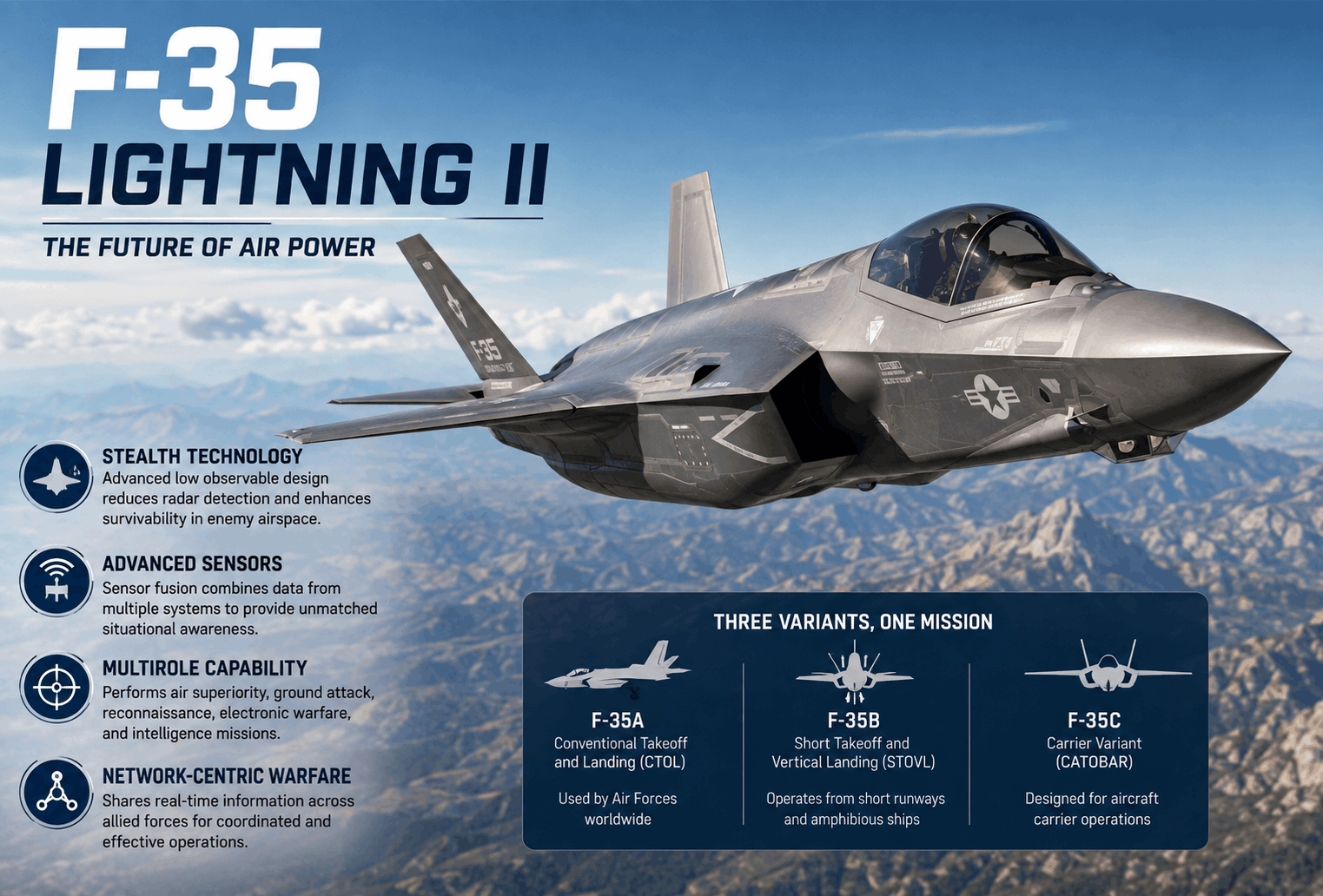
The F-35 Lightning II is one of the most advanced multirole fighter jets ever developed. Designed by Lockheed Martin, the aircraft combines stealth technology, supersonic speed, advanced sensors, and network-centric warfare capabilities into a single platform.
One of the F-35’s most significant strengths is its cutting-edge avionics and sensor fusion system. The aircraft integrates information from multiple onboard sensors, radar, and external sources to provide pilots with a comprehensive picture of the battlefield in real time. Instead of processing information from separate displays, pilots receive a unified view through a helmet-mounted display system, improving situational awareness and decision-making. This technological advantage enables the F-35 to detect and engage threats before they become aware of its presence.
The F-35 program includes three distinct variants designed for different military requirements. The F-35A is the conventional takeoff and landing version used by many air forces around the world. The F-35B features short takeoff and vertical landing (STOVL) capability, making it ideal for operations from amphibious assault ships and short runways. The F-35C is designed for aircraft carrier operations, featuring larger wings and reinforced landing gear for catapult launches and arrested landings. Together, these variants allow allied forces to operate a common aircraft across diverse missions and environments.
Despite its technological achievements, the F-35 program has also faced challenges, including high development costs, maintenance complexity, and ongoing software upgrades. However, continuous improvements have enhanced the aircraft’s reliability, combat readiness, and operational capabilities. As more countries adopt the F-35, it continues to play a central role in modern defense strategies, strengthening interoperability among allied nations while setting new standards for fifth-generation fighter aircraft in the 21st century.